


By Reema Tarek
Cars drive past in steady streams, their engines humming, their tires gliding across asphalt so smoothly that it feels effortless. Few drivers stop to think about the invisible calculations behind them. For Youssef El Atawi, those calculations are never invisible. They are responsibility.
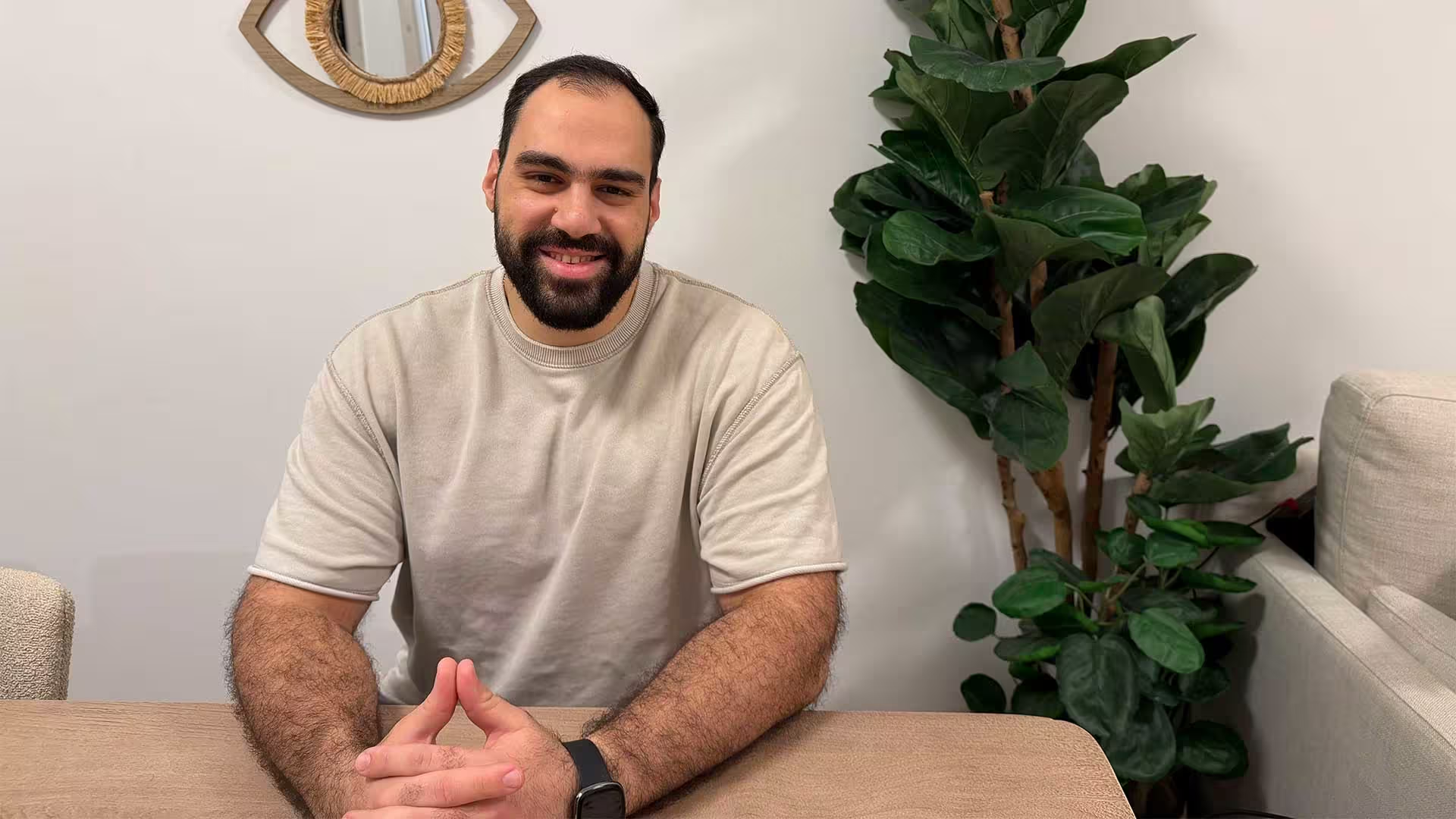
When we spoke, El Atawi sat comfortably in a beige oversized shirt and matching sweatpants, a look that balanced ease with quiet confidence. His dark beard framed a focused expression, and his posture carried the build of someone disciplined. He is visibly strong, broad shouldered and athletic, the kind of physique that does not happen accidentally. The gym, he later explained, is where he releases pressure after long days of road design and stressful deadlines. As he spoke about his career, he used his hands naturally, sketching invisible road curves in the air as if still drafting on a screen or drawing on a paper. He often paused before answering, thinking carefully, then responded with assurance. Even in silence, there was confidence.
At his desk in Dubai, digital road networks stretch across his screen in grids of lines and measurements. Each line will eventually carry thousands of people every day. “If the work isn’t good, you need to do better,” he said. “You will be asked to redo it until it is perfect.”
A spring 2019 graduate from the American University of Sharjah, El Atawi now works as a highway design engineer in one of the region’s fastest growing cities, Dubai. His journey from university classrooms to designing complex road systems reflects discipline, patience and precision. His interest in engineering began with something simple. He loved to draw. Architecture once seemed like the obvious path, but he chose civil engineering for its long-term stability. Selecting AUS was intentional. “It has a strong reputation,” he said. “Many companies still talk about it.”
What began as a practical choice evolved into a passion. During his time at AUS, Professor Akmal Abd Al Fatah’s highways course reshaped his vision. Under his guidance, El Atawi completed a senior design project analyzing road networks and proposing solutions. As he described that project, his hands moved again, outlining intersections midair.
“He made me fall in love with highway engineering,” he said. “The project opened my mind to visualize and to think outside the box.”
Graduation, however, did not remove uncertainty. He paused before admitting, “Nothing prepares you for the real world.” University, he said, was only a “trailer” for what comes next.
In the Middle East, civil engineering deadlines are intense. Projects move quickly and expectations are high, which is why new engineers often struggle with the pace. El Atawi believes AUS unknowingly prepared him in a way nowhere else could. The demanding coursework and constant submissions built resilience.
“The stress of real deadlines didn’t feel as overwhelming,” he said.
His first job required humility. He had to master specialized software, review technical manuals and learn regional design codes.
“You might know the theory,” he said, pausing again before finishing, “but you must follow the code perfectly.”
Unlike university assignments, professional errors carry real consequences. Roads are not abstract concepts. They carry families, workers and entire communities. Every calculation affects safety. That weight shows in the way he speaks about responsibility, shoulders squared, voice steady.
After graduation, El Atawi completed his military service, an experience that strengthened his patience. During the interview, he emphasized the importance of patience in the field as engineering projects demand coordination with clients, consultants and authorities, each with distinct expectations.
“You are dealing with different personalities,” he said. “You must stay professional.”
Moreover, perfectionism remains one of his biggest challenges. “I try to complete my work to the utmost,” he said. “But sometimes we don’t have time for that level of perfection.” That is where balance becomes essential. His athletic build reflects routine discipline, not just aesthetic choice. The gym is not a hobby. It is a strategy. It allows him to reset mentally and physically after navigating high pressure environments.
“As I continue to grow, the responsibilities grow with me,” he said. For current engineering students, his advice is practical and straightforward. Grades matter, but they are not everything. “Experience helps you become socially aware,” he said. “You need that skill in the real world.” He also emphasizes mental health. “You cannot do anything without good mental health,” he said. “Do not take pressure or comments to heart. You will be okay.”
Today, as Dubai continues expanding, El Atawi’s designs quietly shape daily life. Drivers may never know his name. They may never notice the calculated slope of an exit ramp or the seamless merge of lanes, but beneath every smooth commute lies thought, discipline and intention. In a city built on ambition, engineers like El Atawi ensure that growth rests on a solid foundation. Every line he draws carries more than traffic. It carries responsibility.