


By Rama Al-Mekhlafi
“Oh my God, what are you doing here?”
Ibtehal Mohammad still remembers the shock in the voice of an Emaar industry professional who stopped at her first university exhibition and stared at her concept for a retail perfume shop. It wasn’t the compliment that stayed with her, it was what came next: Your idea is unique, but people won’t accept it unless you make them feel something first.
That moment became a rule she now carries into every project: before the materials, the layout, or the renderings, there has to be an emotional connection. And for Ibtehal, a University of Sharjah interior design student preparing to graduate, emotion is not a “nice extra.” It is the purpose of the space.
In conversation, she describes herself with a contrast that matches her work: “I’m a very quiet person, but at the same time, I’m a very active person.” Her creativity starts the way many designers begin, sketching, but she doesn’t treat sketches as final drawings. She treats them as seeds. A single sketch might turn into furniture, a sculptural piece, or an entire environment that guides people through a feeling.
For Ibtehal, interior design stopped being “just a major” when she began studio courses and learned how to create concepts from scratch. She started noticing small, overlooked details, things “people would not notice,” and translating them into spaces that shape behavior. “This is the magic of our field,” she says. “We can control people’s feelings through space.” Her goal isn’t decoration; it is creating a journey that responds to real needs.
Ask Ibtehal to define her design style, and she’s careful not to pretend it’s finished. She describes it as modern, rooted in heritage, and increasingly shaped by technology. To her, heritage gives design “power,” while technology reflects how people already live. She even imagines interiors that include AI and systems that remove friction from everyday experiences, because, as she puts it, “We are living in a technological era.”
Her most public growth, however, happened outside the studio.
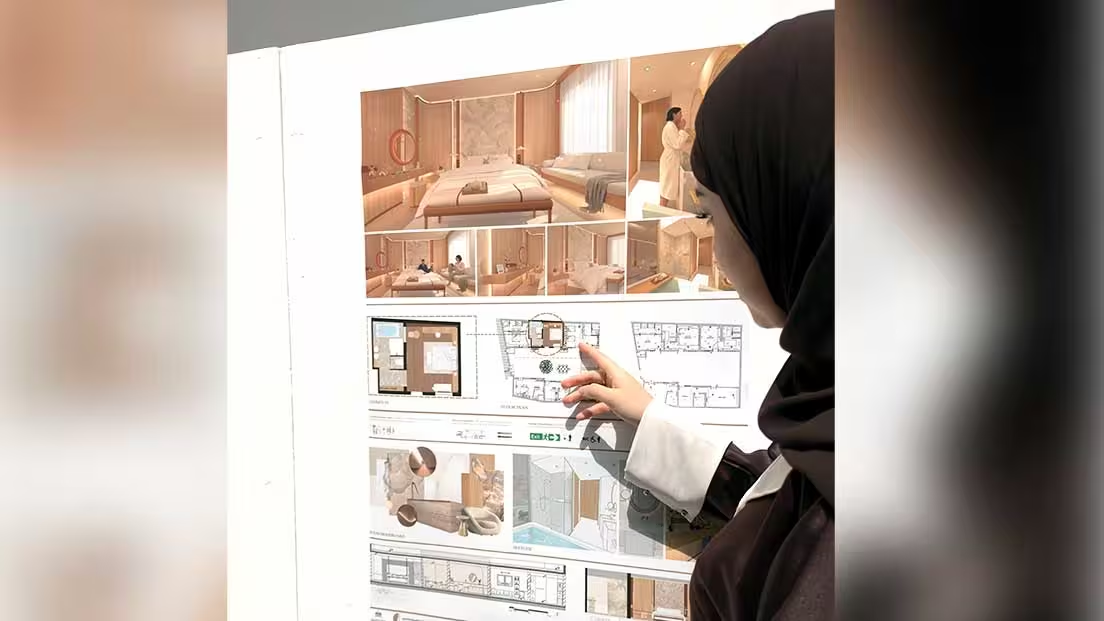
Ibtehal’s projects were selected for yearly university exhibitions, four in four years, and each one forced her to face a different kind of audience. Presenting to professors is one thing; presenting to the public is another. In an exhibition, the person listening might study finance, not design, and their reaction becomes a test: does the concept communicate clearly beyond the classroom?
She admits that early exhibitions made her nervous, not because she feared people, but because she wasn’t ready for “different perspectives.” Feedback sometimes “pushed her down,” she said, but it also showed her the gaps she couldn’t see after spending an entire semester deep in drawings and details. Over time, criticism became a tool: something she could use to improve, not a sign that she should stop.
The perfume shop concept, called “Dejàu,” is where her philosophy sharpened. The space was built as a guided narrative: a darker, colder lighting mood; a step-by-step journey; and technology that made the experience feel new, including AI and self-payment systems. Instead of being told the “best-selling perfume,” visitors would discover stories through the space itself. But the Emaar professional’s advice reframed everything: the idea was strong, yet the presentation needed to lead with feeling so audiences could accept the rest.
That same lesson is now colliding with a new reality, her internship.
University, she explains, gives you time: one project, one semester, one outcome. Work does not. In her internship, priorities shift fast. A supervisor can interrupt a task mid-flow and replace it instantly with a new one. During her first week, the pace triggered what she describes as a panic attack. The adjustment demanded time management, fast decisions, flexibility, and attention to detail, all the while competing for limited opportunities to “take a spot in projects.”
Then there is the part design students rarely romanticize: budget. In university, imagination can go “maximum.” In the industry, the budget is always present, shaping what is possible and how quickly you have to adapt.
Some of the most surprising lessons came from tasks she never expected to exist. One assignment required her to create packaging for artworks, technical drawings for boxes, material choices, shipping considerations and even insurance. She spent about three hours figuring it out, then finished it by the end of the day. The experience wasn’t just a new skill; it was a wake-up call. “From here, I noticed that I know nothing,” she says, then corrects herself: she knows some things, but not enough to stop learning.
While she’s learning the speed of professional work, she’s also building a senior project that explains why she chose design in the first place.
Ibtehal didn’t want a beautiful concept with “zero meaning to people.” Her research led her to a gap she believes matters: low awareness of autism and a lack of suitable spaces where people with autism can learn, develop and feel at home. She designed “Charge Academy,” an artistic employment academy intended to provide education, training and job opportunities, while also creating integration.
At first, her design missed something essential: a social hub. She understood the gap and changed course. If the goal is inclusion, the community needs a place to meet, host events and understand abilities, not only observe them from a distance. In her plan, the social hub becomes the bridge between growth inside the academy and acceptance outside it.
If there is one misconception she wishes people would drop, it is the idea that interior design is “just decoration.” She compares careless design to wearing luxury brands that don’t belong together, each item expensive, but the overall result “awful and cheap.” Good interiors, she argues, come from balance, context and function, not trends, not random luxury and not mixing styles without purpose.
Her advice to students is direct: show your work. If the opportunity doesn’t come, look for it. Public feedback builds confidence, connections, and clarity. “Don’t be shy,” she says. “Present your work. It is good enough.”
The line that ties her story together is the one she learned early: emotion first. Whether she’s designing a perfume shop that feels like a guided story, packaging artwork safely behind the scenes, or building an academy meant to include people too often left out, Ibtehal keeps returning to the same idea.
Spaces don’t just hold people.
They shape what people experience inside themselves.